
Gage County Criminal Court Cases
Two clerks divide the local criminal caseload at the Gage County Courthouse, 612 Grant Street in Beatrice. Gage County Court, in Room 17, hears misdemeanors, infractions, city-ordinance violations, extraditions, and felony preliminary hearings. Its clerk counter is open from 8 a.m. to 5 p.m. on weekdays, including lunch, except holidays. The published phone is 402-223-1323. This is the first court record stop for most lower-level prosecutions and for the early stage of a felony.
The Gage County District Court clerk keeps felony trial files at the same Grant Street courthouse and can be reached at 402-223-1332. A Gage County case may therefore have a County Court number for preliminary proceedings and a later District Court number after bind-over. Nebraska does not operate a separate Beatrice municipal court database. Ordinance cases belong in County Court. The filed public case is ordinarily requested from the clerk, even though the County Attorney created the complaint or information.
Gage County Misdemeanor Counter
Room 17 is more than a payment counter. Its docket can contain the first appearance, bond activity, pleas, hearings, filed charges, and outcome for a Gage County misdemeanor. It also holds the preliminary record when a felony starts in County Court. That split matters because a search limited to District Court can miss the opening phase, while a County Court result may stop before the felony judgment.
The official Nebraska Judicial Branch directory confirms the court's Beatrice location and contact route. Use the clerk for a plain copy, a certified judgment, or help tracing an older file. Current copy and certification prices were not published in the sources, so ask for a quote before ordering. The assigned capture comes from the county's Gage County Court page.
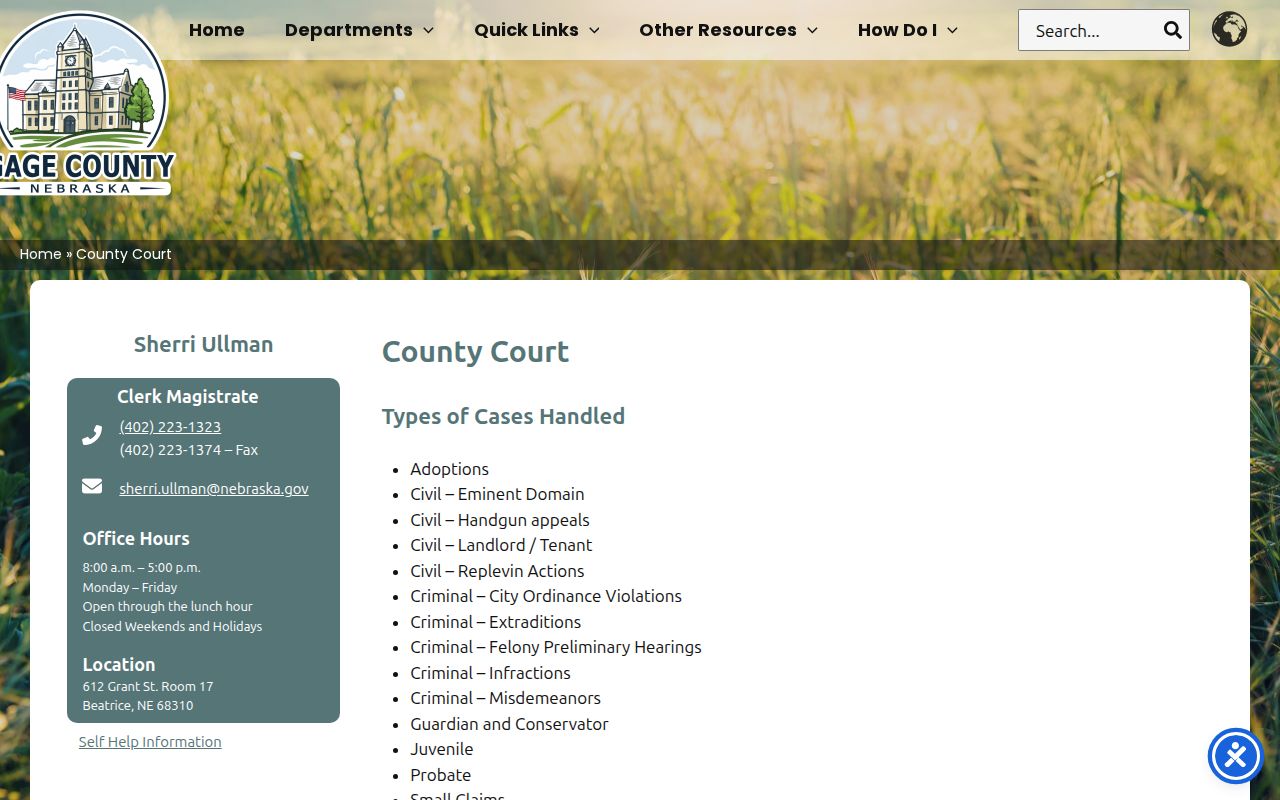
The page places misdemeanor and city-ordinance records at the same local counter that handles felony preliminary matters, which helps a reader choose the right file first.
Searching Gage County Case Records
Nebraska JUSTICE case information services provide paid web access, while courthouse kiosks and specified law-library terminals provide free searches. The one-time party-name search costs $15 and returns up to 30 records without document images. Subscriber access costs $100 per year; a case detail, case-number search, or judgment-date search costs $1, and eligible images carry no added charge. Choose the route based on whether a name list, a known case number, or an actual filed order is needed.
- Open JUSTICE and choose the one-time, subscriber, or free terminal route.
- Select Gage, the criminal case type, and County Court or District Court.
- Search by party name, or preserve the exact spacing and zeros in a known case number.
- Read the summary, offenses, financial entries, and register of actions in date order.
- Ask the correct Gage County clerk for an unavailable image, archive file, plain copy, or certification.
| Field Label | Type | Required | Notes |
|---|---|---|---|
| Party Name | Text | Varies | Used for one-time and subscriber party searches |
| Court Type | Select | Unspecified | Choose County Court or District Court |
| Case Type / Subtype | Select | Unspecified | Choose the criminal subtype offered for that court |
| County and Year | Select | County varies | Select Gage; year can narrow results |
| Court Case Number | Text | For that mode | Separate $1 subscriber query; exact number works best |
The assigned JUSTICE image comes from the Judicial Branch's service page and illustrates the official access choices rather than a commercial people search.
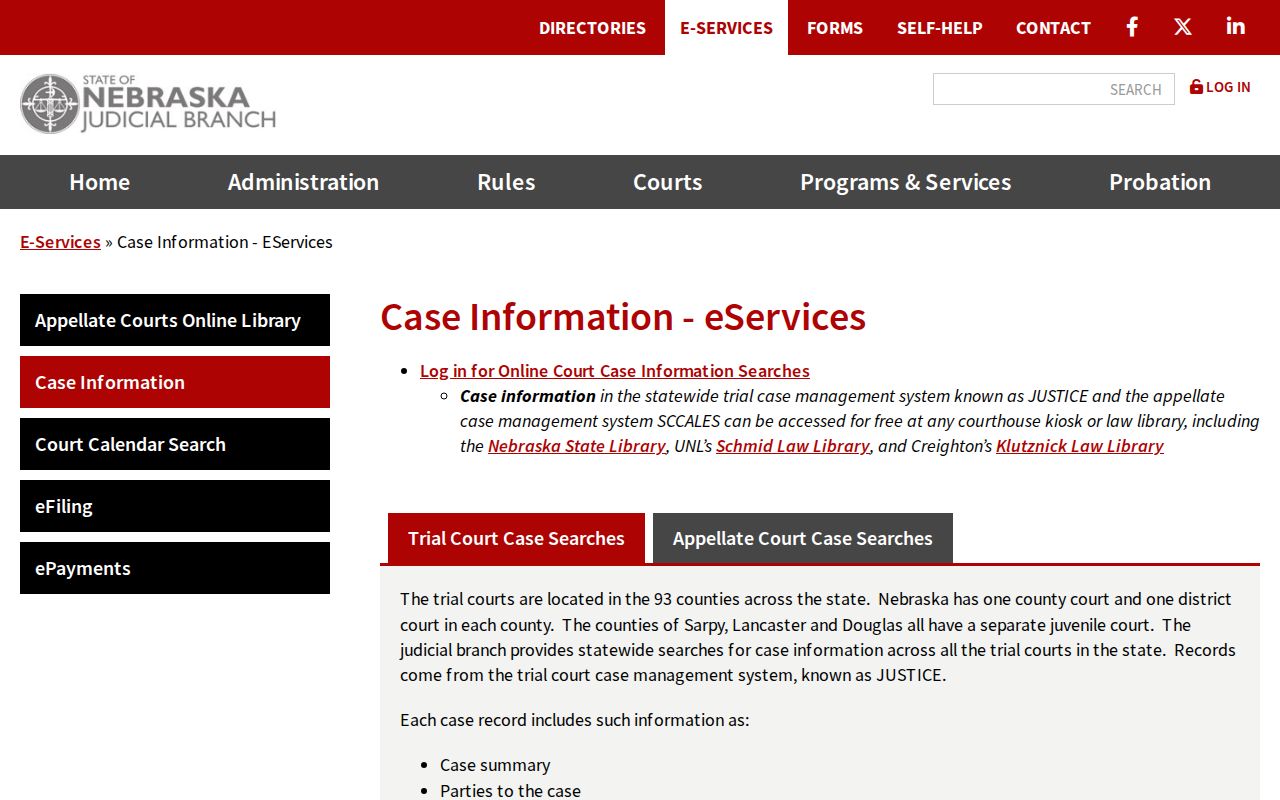
Its service tiers explain why the least costly path can change when a reader needs a filed complaint or judgment rather than a list of possible names.
Free Gage County Case Terminal
A paid web search is not the only official route. Nebraska provides free JUSTICE access at courthouse kiosks and specified law libraries. At the Gage County Courthouse, a reader can search first and then ask the clerk about the exact document. This route is useful when the one-time product's 30-result cap or lack of images would leave the question unresolved.
Terminal access does not make every document public. Older paper files, sealed material, confidential filings, and documents limited by court policy may still require clerk review. Ask whether a missing item can be inspected, copied, certified, retrieved from an archive, or is legally restricted. A sheriff's public-record request is not a substitute for a request to the court custodian.
Note: A printed search screen is not necessarily a certified court record; certification must come from the clerk who holds the filing.
Inside a Gage County Case File
A Gage County court file centers on the filed prosecution, not the jail intake label. JUSTICE can show the case summary, parties, criminal offense information, assessed and paid financial items, the register of actions, and judge notes when applicable. Subscriber detail may link eligible document images. Review all counts because one charge can be dismissed while another ends in a plea or judgment.
| Case Number & Court | Identifies the Gage County court level, filing, and local case. |
|---|---|
| Charging Document | Complaint, information, or indictment stating the filed accusation. |
| Register of Actions | Chronological list of filings, hearings, orders, and docket events. |
| Offense Information | Charge description, statute, class, and changes shown in the court record. |
| Disposition & Judgment | Pending, dismissed, acquitted, convicted, or later set-aside status by count. |
| Sentence & Financials | Sentence, probation, costs, judgments, payments, and bond data when recorded. |
Use the complaint or information to identify the filed accusation, then pair it with the disposition and judgment for the outcome. A docket entry may summarize an order without replacing the signed document. When exact wording matters, request that filing from the Gage County clerk and ask whether a certified copy is needed.
Gage County Ordinance Cases
Beatrice, Wymore, and Blue Springs do not feed a separate municipal court portal. Gage County Court expressly hears city-ordinance violations along with misdemeanors and infractions. Select Gage and County Court in JUSTICE, then search by the party or exact case number. A city name may describe where conduct occurred, but the filed case sits in the state-operated county court system.
If a citation does not appear, check the spelling and number, allow for filing delay, and call Room 17. A payment search is not a substitute for the complete case record because it may omit the register of actions, charging document, and final judgment. Likewise, a city police report tells what the agency recorded about the event, not what charge the Gage County Attorney ultimately filed.
This local arrangement saves a false stop at city hall. It also means the free courthouse terminal and the County Court clerk can answer city-ordinance record questions through the same official channels used for other lower-level Gage County criminal cases.
Read Gage County Docket Events
The register of actions is the best starting point for reconstructing what happened. Read it from the first filed complaint through the latest order. An arraignment is the formal charge-and-plea hearing. A disposition is the result. A bind-over marks movement from a County Court preliminary case toward a District Court felony file. A set-aside is a later order that changes the conviction's legal effect but does not erase the historical docket.
- Nolle prosequi
- The prosecutor declines to continue that charge.
- Acquittal
- A not-guilty result, distinct from a dismissal.
- Register of actions
- The dated court index of filings, hearings, and orders.
- Bind-over
- Movement of a felony matter beyond the County Court preliminary stage.
Financial balances alone do not prove that a criminal sentence remains active. Costs and judgments may persist after other parts of the case end. When the RAP and docket conflict, obtain the filed disposition and ask the source court or agency to send the correction to the Nebraska State Patrol.
How a Criminal Case Moves
The Gage County Attorney reviews a referral and decides whether and what to file. A misdemeanor remains in County Court. A felony can begin there with first appearance, bond, and a preliminary hearing, then move to District Court for arraignment, motions, a plea or trial, judgment, and sentence. The clerk's docket may trail a new arrest, so a recent jail event without a case result is not proof that charges were declined.
Case flow: Charges Filed › Arraignment › Pretrial › Plea or Trial › Disposition › Sentencing
A later appeal, probation order, or set-aside motion can add entries long after sentencing. Readers with two case numbers should check both court levels and ask County Court whether the preliminary matter was bound over. The Gage County arrest lookup explains why an intake charge can differ from the charge that is filed.
Gage County Felony File
The District Court clerk at 612 Grant Street is the local custodian for a felony trial file after bind-over or direct filing. The assigned capture comes from the official Gage County District Court clerk page.
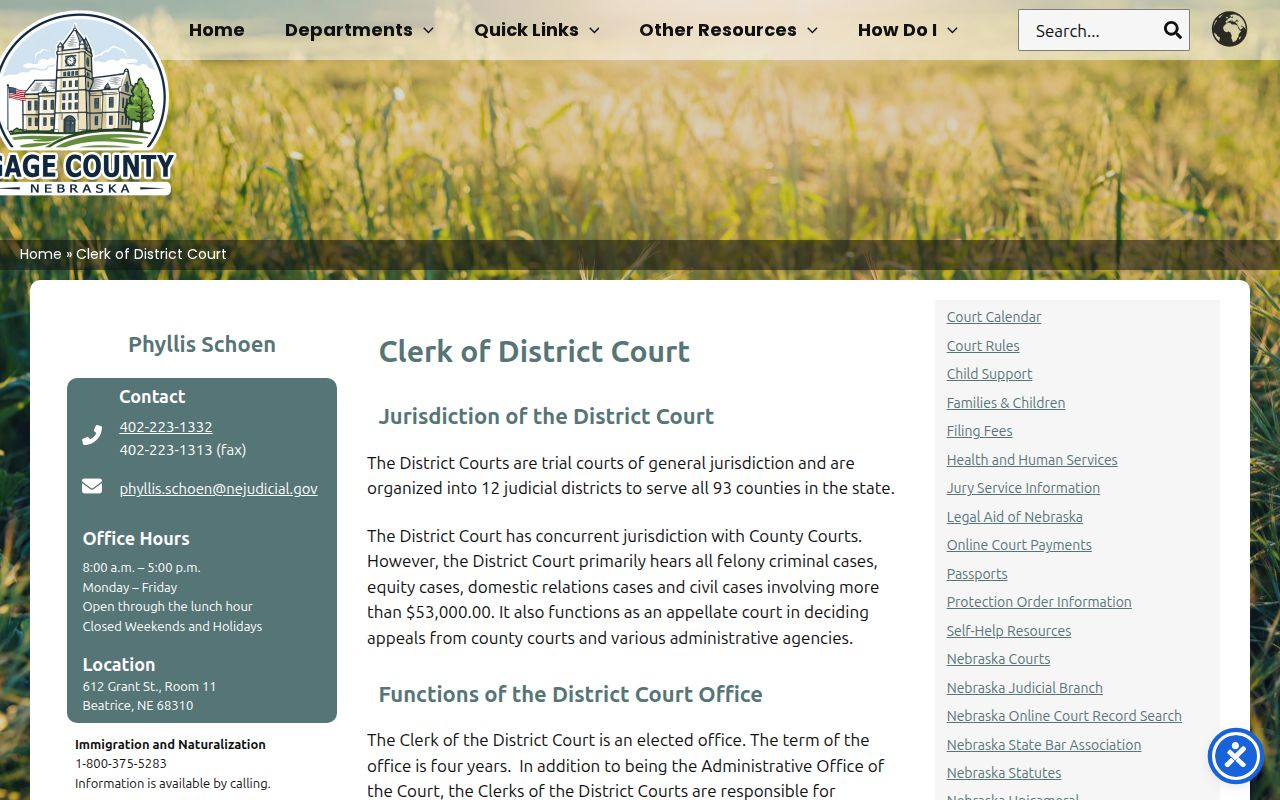
The shared courthouse address can hide a key distinction: County Court and District Court remain separate dockets. Give the clerk the exact case number when possible. If only the preliminary number is known, ask whether a later District Court number was assigned. For an old or unavailable image, ask about paper inspection, archive retrieval, copying, and certification without assuming the record is sealed.
Case Record Access & Restrictions
The Nebraska court records search policy governs official trial-court searches. Public access does not mean that each field or image appears online. Juvenile matters, sealed files, sensitive identifiers, victim information, and document-level confidential material can be withheld or redacted. A missing online result can also reflect an older paper file, filing delay, different spelling, or movement between court levels.
Nebraska's Public Records Act applies subject to specific exceptions, but filed court records should be requested from the proper Gage County clerk. Under Neb. Rev. Stat. §29-3523, some nonconviction information later becomes unavailable on the public NSP RAP. That rule does not automatically delete a court docket. Likewise, a conviction set aside under §29-2264 remains visible with the later order. Confirm the meaning of any access limit with the clerk rather than treating a blank search as proof that no case exists.